
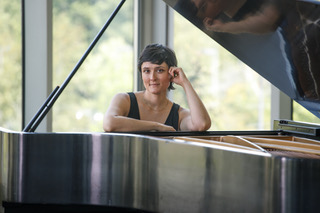
Since 2022, when pianist Morgan Lee moved to Maine with a Doctor of Musical Arts degree in
hand from the University of Connecticut, Storrs, she’s viewed the state as “a place where I could
see building a professional life and building a family and putting down roots and securing
resources and support. I’ve been really lucky that it’s all worked out so far.”
Lee’s next Maine-based success story will emerge March 21 in Lewiston and March 22 in
Topsham when she solos with the Midcoast Symphony Orchestra (MSO) in Beethoven’s Fourth
Piano Concerto, with Jinwook Park mounting the MSO podium again as a guest conductor. The
rest of the program, titled “Ambition and Destiny,” will begin with Von Weber’s Oberon Overture
and conclude with Tchaikovsky’s Fourth Symphony. Go to midcoastsymphony.org for more
concert details and to purchase tickets.
Lee, who lives in Waterville, began preparations for her coming MSO appearance last summer,
carving out time in a busy schedule to master what is arguably the most distinctive, revered and
challenging of Beethoven’s five piano concertos. The schedule underscores the fact that she’s
become one of the most productive and versatile musicians in The Pine Tree State:
- She teaches privately and at various schools, including Bay Chamber Music School and Colby College, where Park serves as the music director of its Symphony Orchestra.
- She takes on the occasional concerto project; in 2024, for example, she soloed in an Augusta Symphony performance of Mozart’s Piano Concerto №23.
- She plays not only piano but also celeste and synthesizer as a substitute keyboardist with the Portland Symphony Orchestra.
- Lee’s role as collaborative pianist is extensive. It has her working with the Colby College Chorale, the Colby College Collegium, and the Unitarian Universalist Community Choir in Augusta.
- Finally, Lee’s not afraid to challenge notions of what a classical musician can do. Witness her work with the Portchlight Ensemble, which describes itself as “a collective of classical musicians, artists, and makers who devise interdisciplinary performances connecting classical repertoire to Maine stories.” Portchlight builds on ideas that Lee first developed in “Interdisciplinary Co-Creation: A New Creative Practice for Musicians,” her doctoral dissertation.
In Lee’s view, the incredible diversity of the aforementioned experiences has paid off
handsomely, particularly in the depth of her approach to the Fourth. She cited one example to
illuminate what she meant: By occasionally playing (as a keyboardist) in an orchestra rather
than in front of one, which will be the case next month, she has gotten to watch the solo work of
several guest artists.
“I’ve been seeing a lot of different styles of how they interact with conductors and orchestras,”
she said. “And because of that, I’m much more aware of fundamental things. There are certain
moments where you really have to connect with the conductor or really listen to your orchestra
for things to meld well. This is something that we pianists are always taught, but until I sat in an
orchestra, I didn’t fully appreciate what it meant in practice.”
Lee is clearly looking forward to sharing her interpretation of Beethoven’s Fourth Piano
Concerto, having come to see it as an indispensable part of her pianist journey. The three-
movement work is a towering masterpiece that, remarkably, received its first public performance
in 1808 when Beethoven played it on a five-hour program — which also included the premiere
performances of the composer’s Fourth and Fifth Symphonies, his Mass in C, and his Choral
Fantasy.
The Fourth Piano Concerto has revealed to Lee a composer who’s more complex and reveals
far more subtleties than the mythologies that swirl around him often suggest (e.g., Beethoven
overcame the adversity of deafness to compose his Ninth Symphony).
“I think the Fourth really showcases those subtleties,” she said. “There’s so much in it. It’s been
described as a really tender piece, and I think tenderness is a good word for it, but I also think
sincerity and spirituality are good descriptions.”
Leave a Reply